
Muskie Fishing: The Full Guide to the Fish of 10,000 Casts

This post may contain affiliate links. We may earn a commission at no extra cost to you. See our full disclosure.
Some fish you catch by accident. Muskie you earn. These are the largest purely freshwater members of the pike family, capable of pushing 50 inches and topping 30 pounds in the right water — and they’ve built a reputation for making anglers wait, sometimes for days, between meaningful encounters.
If you’re ready to put in that kind of time, today we’re going to highlight everything that makes effective muskie fishing tick and how to tip the odds in your favor.
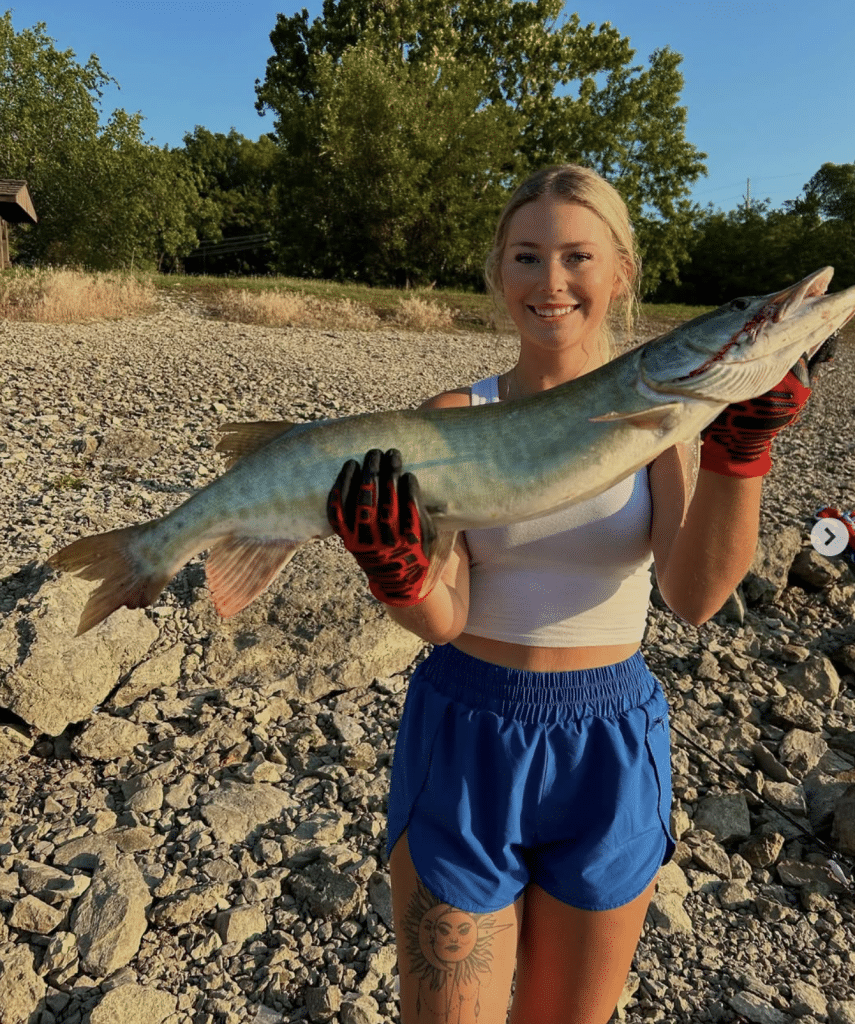
Quick Facts Table
| Category | Details |
|---|---|
| Scientific Name | Esox masquinongy |
| Common Names | Muskie, musky, lunge, maskinonge, ski |
| Average Size | 28–48 inches, 15–36 lbs in quality waters |
| Trophy Size | 45–50″+ or 30–40+ lbs; 50+ lbs exceptional |
| World Record | 69 lb 11 oz, Louis Spray, Chippewa Flowage (WI), 1949 |
| Lifespan | 12–18 years typical; up to 30+ years in northern waters |
| Habitat | Cool to warm vegetated water, large lakes, rivers, bays |
| Best Water Temp | 50–75°F active; 50–60°F spawn; 67–72°F optimal feeding |
| Top Forage | Perch, suckers, other fish |
| Top Fisheries | Lake of the Woods, St. Lawrence River, Georgian Bay |
Pike’s Bigger, Rarer Relative
The muskellunge (Esox masquinongy) — muskie for short — sits at the top of the pike family by size, with exceptional fish approaching 6 feet and 70+ pounds. Even the name carries some weight: it comes from the Ojibwe “maashkinoozhe,” often translated as “ugly pike,” a fitting description once you’ve gotten a close look at that jaw full of teeth.
Anglers new to muskie often assume they’re just oversized northern pike, and the confusion is understandable — same family, same ambush-predator build, same duck-bill snout.
But muskie occur at much lower densities, grow considerably larger, and have a well-earned reputation for ignoring lures that pike would crush without hesitation. That combination is exactly where “the fish of 10,000 casts” comes from.

Identifying a Muskie
| Feature | Muskie Characteristics |
|---|---|
| Body Shape | Elongated, torpedo-shaped |
| Color/Markings | Dark vertical bars or spots on silver/olive/bronze background (markings can fade or vanish in turbid water) |
| Snout | Duck-bill shape, large mouth, sharp teeth |
| Gill Cover | Scales only on the upper half (opposite of pike) |
| Jaw Pores | 7 or more sensory pores on the underside of the lower jaw |
| Tail Fin | Sharper, more pointed lobes than northern pike |
When markings alone aren’t conclusive — and in stained water, they often aren’t — count the pores on the underside of the lower jaw. Seven or more means muskie; five or six means pike.
The gill cover tells the same story from a different angle: muskie carry scales only on the upper half, while pike have the cheek fully scaled. Between the two checks, identification becomes pretty unambiguous.

Muskie Habitat
Muskie occupy cool to warm, vegetated water in large lakes, rivers, and bays, gravitating toward shallow weedy areas, structure, and drop-offs where ambush opportunities present themselves.
Their optimal feeding range runs 67–72°F — a touch warmer than what most anglers associate with northern pike — though muskie handle a fairly broad temperature range overall.
Where Muskie Fishing Excels
- Minnesota/Ontario — Lake of the Woods consistently ranks among the best big-muskie waters on the continent
- New York — both the St. Lawrence River and Chautauqua Lake carry long-standing reputations
- Ontario — Georgian Bay’s extensive weed structure makes it prime muskie habitat
- Wisconsin — Green Bay produces well, and the Chippewa Flowage holds historic significance as the world record water
- Minnesota — Mille Lacs supports a notable muskie population in addition to its other fisheries
- Kentucky — Cave Run Lake stands out as one of the southernmost quality muskie destinations
- Core native range — the Great Lakes/St. Lawrence system, upper Mississippi, and Ohio River basins anchor the species naturally, with stocking programs extending opportunities well beyond that range

When to Fish for Muskie
Spring, especially May through June, sees post-spawn muskie shift into recovery and feeding mode.
Summer sends fish toward deeper structure, with low-light periods carrying outsized importance as muskie largely avoid the brightest, warmest stretches of the day.
Fall is the season most dedicated muskie anglers build their year around — cooling water triggers some of the most aggressive feeding muskie display, often extending well beyond typical dawn-and-dusk windows into genuine all-day opportunity.
Year-round targeting is technically possible, including limited ice fishing in the far north, but fall remains the clear standout.
Water Temperature Guide
| Temp Range | What’s Happening |
|---|---|
| 50–60°F | Spawning period |
| 50–75°F | General active range |
| 67–72°F | Optimal growth and feeding |
| Cooling fall temps | Peak aggression window |
May through June lines up with post-spawn recovery and feeding, while September through November brings the fall surge that defines the muskie season for most serious anglers.
Conditions That Help
Overcast skies, wind, and a barometer trending stable-to-falling line up with classic muskie conditions — reduced light and visibility seem to make these notoriously cautious fish more willing to commit.
Dawn, dusk, and other low-light windows remain generally productive, but cooler water can flip the script entirely in fall, with muskie feeding aggressively at almost any hour once temperatures settle into that optimal range.

Lures, Bait, and Techniques
Matching Lures to the Moment
| Condition | Top Lure Choices |
|---|---|
| General casting, weed edges/structure | Large bucktails |
| Reaction strikes, aggressive fish | Jerkbaits, large spoons |
| Surface activity, shallow fish | Topwater walkers |
| Covering water/trolling | Crankbaits, swimbaits |
| Sight-fishing/follow situations | Any of the above, finished with a figure-8 |
Color choices that consistently show up in muskie tackle boxes lean flashy and high-contrast — chartreuse, black, and orange in particular. In low light or stained water, giving a muskie something easy to spot can make the difference between a follow and a strike.
Live and Dead Bait Options
- Large suckers — the classic choice for anglers specifically targeting trophy-class fish
- Chubs — a useful alternative, particularly effective in smaller waters
- Perch — effective where legal, matching natural forage
- Dead bait rigs — an option when cold water slows everything down, including muskie metabolism
How Muskie Get Caught
Casting bucktails and jerkbaits along weed edges, points, and structure forms the backbone of muskie fishing — methodical, repeated coverage of the areas most likely to hold fish.
Trolling large crankbaits or swimbaits covers more water than casting alone and can be particularly effective on big lakes or when searching broadly for active fish.
The figure-8 isn’t really optional technique — it’s standard practice. At the end of every cast, tracing a figure-8 with the lure right at the boat gives a following muskie one more reason to commit. Skipping it, especially on a fish that’s followed all the way in, routinely costs anglers their best shot of the day.
Large streamer fly fishing has become a real niche within muskie fishing, particularly for sight-fishing situations in clear, shallow water.

Where Anglers Lose Opportunities
Skipping the figure-8 after a cast is probably the single most common way to miss a fish that was genuinely interested. Undergunned tackle is another — muskie demand heavy baitcasting setups and wire leaders, not a bass rod scaled up slightly.
Treating a slow day as a sign something’s wrong, rather than as the normal rhythm of muskie fishing, leads a lot of anglers to give up right before things turn.
And fishing the same depth and presentation regardless of season ignores how dramatically muskie shift — shallow weeds in spring and fall, deeper structure once summer sets in.
While You're Here
69 of the Most Insane Things Found on Facebook Marketplace
Real listings. Real people. Unreal decisions.

Feeding, Spawning, and Behavior
Feeding
Muskie are committed ambush predators, with perch, suckers, and other fish forming the core of their diet, though they’ll opportunistically take birds, small mammals, and crayfish when the chance arises.
Like their northern pike relatives, muskie are cannibalistic, with larger fish preying on smaller muskie. Young fish start on zooplankton before moving to a fish-based diet relatively quickly.
Spawning
- Occurs in early spring, triggered by water temperatures of 45–65°F
- Muskie are broadcast spawners — no nest-building, no parental care afterward
- Spawning takes place in shallow, vegetated bays and marshes
- Females can produce anywhere from 22,000 to over 450,000 eggs, depending on size
- Egg and fry mortality is extremely high naturally, which is a major reason so many muskie fisheries depend on stocking to stay viable
Growth and Behavior
The fastest growth happens in the first three to five years, and as with northern pike, females outgrow and outlive males by a meaningful margin — true trophy muskie are almost always female.
Reaching legal or trophy size generally takes 5 to 10+ years depending on available forage, and a 50-inch fish typically represents 10 to 20+ years of growth.
Muskie live largely solitary, territorial lives at naturally low population densities — a combination that makes them genuinely special, and genuinely difficult to locate consistently.


Records and Trophy Potential
| Record Type | Details |
|---|---|
| All-Tackle World Record | 69 lb 11 oz, Louis Spray, Chippewa Flowage (WI), 1949 |
| Notable State Records | Wisconsin and New York both have historical fish near 69 lbs |
| Maximum Size | Nearly 6 feet and 70+ lbs in exceptional cases |
| Notable Pattern | Many 50+ inch fish are caught and released in modern trophy fisheries |
Louis Spray’s 69 lb 11 oz muskie from the Chippewa Flowage has held since 1949 in some record books, though catches from that era have long drawn scrutiny and debate over verification.
What matters more for today’s anglers is the modern standard: serious muskie fisheries run almost entirely on catch-and-release for large fish, which means a properly measured and released 50-inch muskie carries essentially the same weight as a “record” for most who chase them.

30 Muskie Facts Worth Knowing
Biology Facts
- Muskie are the largest purely freshwater member of the pike family.
- The name comes from the Ojibwe “maashkinoozhe,” roughly meaning “ugly pike.”
- Muskie can reach burst speeds of 30 mph when attacking prey.
- 7 or more mandibular pores distinguish muskie from northern pike’s 5–6.
- Gill cover scaling — upper half only — provides a second confirmation against pike.
- Females grow significantly larger than males and generally live longer.
- Muskie can hybridize with northern pike to produce sterile tiger muskies.
- Markings and coloration vary by strain and water clarity, occasionally disappearing almost entirely.
- Fry begin on zooplankton before transitioning to a fish-based diet.
- Despite a fairly narrow optimal feeding range, muskie tolerate a wide overall temperature span.
Angling and Behavior Facts
- Muskie use both smell and lateral line alongside vision to track prey.
- Hooked muskie are known for powerful runs, head shakes, and occasional jumps.
- The figure-8 at boatside is considered essential on every single cast.
- Muskie frequently strike lures noticeably larger than what their actual prey suggests.
- Electronics are critical for locating the structure and weed edges muskie favor.
- Depth use shifts seasonally — shallow in spring and fall, deeper through summer.
- Topwater strikes from shallow muskie are explosive and visually unforgettable.
- Their wariness drives the species’ reputation for low catch rates and high difficulty.
- Large streamer fly fishing is an established and effective muskie approach.
- Peak feeding activity tends to track forage movements, particularly into fall.
Records and History Facts
- Many muskie waters depend heavily on stocking due to limited natural reproduction.
- That said, a number of fisheries remain genuinely self-sustaining.
- Muskie support specialized guide and lodge industries across the northern U.S. and Canada.
- DNA testing helps researchers identify and track different muskie strains.
- High minimum size limits and slot limits, often 40–50+ inches, are common management tools.
- Lake of the Woods and the St. Lawrence River both rank among North America’s most famous muskie waters.
- The Chippewa Flowage in Wisconsin holds major historical significance as a record-fish water.
- Muskie function as a key apex predator in many of the ecosystems they inhabit.
- Conservation efforts increasingly emphasize habitat protection given muskie’s naturally low densities.
- Muskie remain one of the most coveted trophies in North American freshwater fishing.

Myths Worth Retiring
“Muskie are essentially uncatchable.” Difficult, yes — impossible, no. Consistent effort, the right water, and proper technique (especially the figure-8) produce results over time.
“They only go after huge bait.” Muskie are opportunistic feeders that take a wide range of prey sizes, not exclusively oversized forage.
“Muskie are just big northern pike.” They’re closely related but distinct — mandibular pore count, gill cover scaling, and typical size all set them apart.
Reader Favorite
The "Phone Money" Trick Our Readers Keep Writing In About
Every week we get emails asking the same thing: is there a legit way to make extra money without taking on a second job? The answer that keeps coming back from readers is reward apps that pay real cash for things you're probably already doing on your phone, like answering surveys or playing games while the TV is on.
One reader told us she covers most of her monthly streaming bills this way. Another uses his payouts to pad the grocery budget. It won't replace a paycheck, but an extra $50 to $100 a month for downtime you'd spend scrolling anyway is hard to argue with.
- Free $5 signup bonuses just for joining
- Cash out via PayPal, check, or gift card
- No fees, no experience, nothing to buy
We compared the highest-rated options so you don't have to dig: see the best ways to make money from your phone →
We may earn a commission if you sign up through a link on this page.
“Fall is the only worthwhile season.” Fall is the standout, but spring post-spawn and summer low-light windows also produce solid muskie fishing.
“Any northern lake might hold trophy muskie.” Quality muskie fisheries are specific waters, often shaped by deliberate stocking and management — not a given just because a lake is in the right region.
“Muskie aren’t worth eating.” From clean water, particularly smaller fish, muskie offer good table fare, with some extra care needed for the Y-bones.
“Muskie can’t reproduce on their own.” Many fisheries are self-sustaining; stocking is common but far from universal.
“If a fish follows but doesn’t strike, it’s gone.” A figure-8 at the boat regularly turns non-committal follows into bites — it’s one of the highest-value habits in muskie fishing.

Frequently Asked Questions
Identification and Basics
What’s the clearest way to tell a muskie from a northern pike? Count the pores on the underside of the lower jaw — muskie have 7 or more, pike have 5 to 6. Gill cover scaling backs this up: muskie show scales only on the upper half, while pike have a fully scaled cheek.
What size counts as a trophy muskie? Generally 45–50″+ or 30–40+ lbs, with anything past 50 lbs considered exceptional.
How old is a 50-inch muskie likely to be? Often 10 to 20+ years — even in productive water, reaching that size takes a long time.
Gear and Tackle
What rod and reel setup do muskie require? Heavy baitcasting gear with 40–80 lb braid and a wire leader to handle both the size of the fish and their teeth.
From Around Our Desks
One more we think you'll like: the Sunday meal planning system that survived a real family
Is a wire leader truly mandatory? Yes — muskie’s teeth make a wire leader a basic safety requirement for terminal tackle, not an optional add-on.
What hook sizes are common on muskie lures? Large single hooks in the 7/0 to 10/0 range show up frequently.
Why is heavy braid the standard main line? Its strength and abrasion resistance hold up against both large lures and powerful fish, and line visibility is less of a concern for this species than for more wary, smaller fish.
Techniques and Timing
When should I focus on trophy-class muskie? Fall and the post-spawn period in spring tend to offer the most consistent shots at larger fish.
How deep do muskie sit in summer? Often 15–30+ feet, generally tied to defined structure.
Do I really need to figure-8 every cast? Yes — it’s standard practice precisely because muskie so often follow without striking, and the figure-8 is the proven way to convert some of those follows into bites.
Is fly fishing a realistic option for muskie? Yes — large streamers work well, especially for sight-fishing in clear, shallow water.
What colors tend to produce? Flashy, high-contrast options — chartreuse, black, and orange — show up often as productive choices, particularly in lower light.
Are muskie typically found in groups? No — they’re generally solitary or found in very small numbers, consistent with territorial behavior.
Conservation and Regulations
What size limits should I expect for muskie? Often high minimums or slot limits, frequently in the 40–50+ inch range, reflecting a strong trophy-management focus.
Readers Can't Stop Opening These
★ 27 Things Frugal People Stopped Buying (And Don't Miss at All)
Do most muskie fisheries rely on stocking? It varies — many do, given limited natural reproduction, while others maintain self-sustaining wild populations.
Why is catch-and-release emphasized so heavily for muskie? Naturally low population densities and slow growth to trophy size make releasing large fish central to maintaining quality fisheries long-term.
What exactly is a tiger muskie? A typically sterile hybrid between muskie and northern pike, often known for notably fast growth.
General
Are muskie good to eat? Yes, particularly smaller fish — solid table fare from clean water, with some care needed for the Y-bones.
Are muskie suitable for beginners? They can be exciting, but the combination of specialized gear and low catch rates makes muskie more of a dedicated pursuit than a casual outing.
What does “fish of 10,000 casts” actually mean in practice? It reflects how few strikes muskie typically produce relative to effort — persistence and consistency matter more here than for almost any other freshwater species.
Where do the largest muskie on record come from? Wisconsin’s Chippewa Flowage holds the long-standing all-tackle world record, with the St. Lawrence River and other Great Lakes-region waters also producing historically notable fish.

Related Species, Gear, and Next Steps
Muskie share water with northern pike, tiger muskie, walleye, largemouth bass, and yellow perch — and on waters holding both pike and muskie, quick and confident identification matters given the differences in size expectations and required tackle.
| Gear | Why It Matters |
|---|---|
| Large bucktails | A foundational lure for weed edges and structure |
| Jerkbaits and large spoons | Reliable for triggering reaction strikes |
| Topwater walkers | Productive for explosive shallow-water strikes |
| Heavy braid (40–80 lb) with wire leader | Essential for handling both lure size and muskie’s teeth |
| Quality electronics | Critical for locating structure and weed edges |

Final Thoughts
Muskie fishing rewards patience as much as skill — knowing the seasonal patterns, committing to the figure-8 on every cast, and treating a quiet day as part of the process rather than a failure.
Whether you’re working a fall weed edge with a bucktail or trolling a big swimbait through summer structure, the payoff for that persistence is a fish unlike anything else in freshwater.
Tie on something big, stay patient, and make every cast count.
Enjoyed this article? Here are more fun reads:
