
Bluegill Fishing Guide: From First Fish to Trophy Slabs

This post may contain affiliate links. We may earn a commission at no extra cost to you. See our full disclosure.
Almost every angler’s first fish story involves a bluegill, a bobber, and a worm — and there’s nothing wrong with that. But write bluegill off as “just a kid’s fish” and you’ll miss out on genuine slab fisheries where these scrappy panfish push past a pound and put a serious bend in ultralight gear.
For those looking to pursue such a journey, today we are going to deep dive and create a full picture, from basic identification to chasing the biggest bluegill a water can produce.

Quick Facts Table
| Category | Details |
|---|---|
| Scientific Name | Lepomis macrochirus |
| Common Names | Bream, brim, coppernose, sunfish, slab |
| Average Size | 5–10 inches, 0.25–0.75 lbs |
| Trophy Size | 10″+ or 1+ lb; 2+ lbs exceptional |
| World Record | 4 lb 12 oz, “Hudson Hawg,” Alabama private pond, 1950 |
| Lifespan | 5–8 years typical; up to 10–11+ years in good conditions |
| Habitat | Warm, still water with vegetation, brush, docks |
| Best Water Temp | 55–85°F active; 68–75°F+ spawn |
| Top Forage | Insects, larvae, zooplankton, small crustaceans |
| Top Fisheries | Kentucky Lake, Lake Okeechobee, Santee Cooper |
America’s Default Sunfish
If you had to pick one fish to represent “panfish” in the U.S., it would be the bluegill (Lepomis macrochirus) — by most measures, the most widespread and abundant sunfish on the continent. Part of the same family as bass and crappie (Centrarchidae), bluegill were originally native to the eastern and central U.S., but decades of stocking have put them in nearly every pond, lake, and slow river backwater that holds warm water.
The name itself comes from the blue sheen along the cheek and gill cover, a feature that’s noticeable on most fish but becomes especially striking on spawning males, whose breast also flushes bright orange or yellow during that period.

Identifying a Bluegill
| Feature | Bluegill Characteristics |
|---|---|
| Body Shape | Deep, slab-sided, laterally compressed |
| Color | Olive-green to dark back, yellowish sides |
| Gill Cover | Bluish sheen, with a black “ear flap” |
| Mouth | Small — upper jaw doesn’t reach the front of the eye |
| Dorsal Fin | Dark blotch at the rear base of the soft dorsal |
| Markings | Faint vertical bars on sides; bright orange/yellow breast on spawning males |
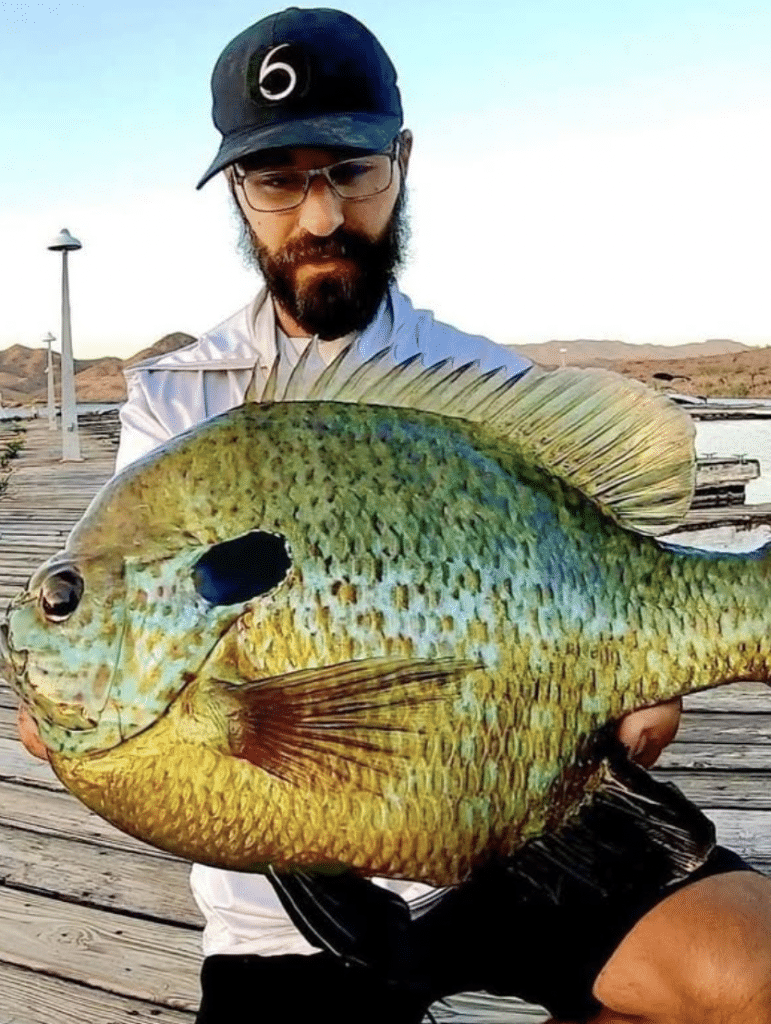
If you’re trying to sort a bluegill from a similar-looking redear sunfish, check the soft dorsal fin first — bluegill carry a distinct dark blotch there that redear lack. Redear instead show a red-edged ear flap and tend to grow somewhat larger.

Bluegill Habitat
Bluegill want warm, slow, or still water — lakes, ponds, reservoirs, and backwaters — and they want it loaded with cover. Weed beds, brush piles, docks, and submerged timber are where bluegill spend most of their time, whether they’re feeding, hiding from predators, or guarding nests.
One trait that separates bluegill from a lot of gamefish: they handle warm, low-oxygen water remarkably well. That tolerance is a big reason small farm ponds — water that would stress trout or even bass — often hold thriving bluegill populations.
Where Bluegill Fishing Excels
- Florida — Lake Okeechobee and similar waters often hold coppernose strains alongside typical bluegill
- Kentucky/Tennessee — Kentucky Lake and Reelfoot Lake have long-standing reputations as panfish destinations
- South Carolina — Santee Cooper’s heavy vegetation makes for classic bluegill water
- Wisconsin/Minnesota — Nelson Lake and similar Midwest waters produce well in open water and through the ice
- Texas/Louisiana — Toledo Bend and other big southern reservoirs hold solid numbers
- New Hampshire — Lake Winnipesaukee represents a strong Northeast option
- Farm ponds and strip-mine lakes — frequently overlooked, but often where the biggest “slab” bluegill actually live

When to Target Bluegill
Spring is when bluegill fishing gets almost unfair — as water warms toward spawning temperatures, these fish become some of the most aggressive, easy-to-catch targets in freshwater.
Early summer keeps that momentum going through and just after the spawn.
Fall brings a solid secondary window as fish feed up before winter. And unlike a lot of species, bluegill genuinely stay catchable all year, including a real ice fishing pattern up north.
Water Temperature Guide
| Temp Range | What’s Happening |
|---|---|
| 55–65°F | Activity increasing, pre-spawn staging |
| 68–75°F+ | Peak spawning activity |
| 65–80°F | Optimal feeding range |
| Above 85°F | Fish may seek deeper, cooler water or shaded cover |
April through June lines up with the spawn for most of the country, and September and October bring a strong fall bite. Southern anglers often see the action stay hot from May through July.

Conditions Worth Knowing
Dawn and dusk are typically the most active windows — except during the spawn, when beds full of territorial males will bite all day long, regardless of light level.
Stable or slowly warming weather helps overall, overcast skies and light rain tend to extend good feeding windows, and a bit of wind hitting a bank can actually stir up insect activity and improve the bite rather than shut it down.

Lures, Bait, and Techniques
Matching Gear to the Approach
| Approach | Top Choices |
|---|---|
| Light spinning, general | Small jigs (1/64–1/32 oz) with grubs or tubes |
| Covering water | Small inline spinners (Rooster Tail) |
| Subsurface, stocked waters | Small soft plastics, scented baits (PowerBait, Gulp!) |
| Fly fishing | Poppers (topwater), small nymphs (subsurface) |
| Crankbait situations | Small crankbaits around cover |
The single most important adjustment most anglers need to make for bluegill is simply going smaller — smaller hooks, smaller lures, lighter line. It’s less about technique and more about scale; bluegill have small mouths, and oversized presentations get ignored constantly.
Live Bait Worth Carrying
- Worms/nightcrawlers — the universal standby, effective nearly everywhere
- Crickets — especially popular and productive in southern waters during summer
- Waxworms/mealworms — excellent on small jigs, particularly when water is cooler
- Small minnows — worth having for targeting larger, more predatory bluegill


How to Fish for Them
Bobber and bait is the classic approach for good reason — a small hook with a worm or cricket suspended near cover or over a bed catches fish reliably, with minimal complexity.
Vertical jigging around docks, brush, and weed edges with small jigs works especially well when bluegill are holding tight to structure rather than roaming open water.
Fly fishing deserves more attention than it gets for bluegill — poppers worked during low light or the spawn, and small nymphs fished subsurface, can produce some of the most engaging panfish action available.
Bed fishing during the spawn means targeting the visible circular nests bluegill colonies create in shallow water — extremely productive, though it’s worth fishing these areas with some restraint (more on why below).
Where Anglers Go Wrong
A lot of slow days come down to gear mismatched to the fish — hooks and line sized for bass simply don’t get bit as often by a fish with a mouth this small. Plenty of anglers also assume bluegill stay shallow all summer, when many fisheries see fish slide out to 10–25+ feet near structure once it warms up.
Hammering nest-guarding males during the spawn can hurt a fishery’s size structure over time if it happens repeatedly. And once bluegill move deep in summer, skipping electronics makes finding those schools largely guesswork.
Feeding, Spawning, and Behavior
Feeding
Bluegill are opportunistic feeders, taking insects, larvae, zooplankton, small fish, crustaceans, and even some vegetation depending on what’s available. In clear water, they’re strong sight feeders — which is part of why lure color tends to matter more for bluegill than many anglers assume. Young bluegill rely heavily on plankton and insects, gradually shifting toward a broader, more omnivorous diet as they mature.
Spawning
- Takes place in spring through early summer, once water reaches 68°F or higher
- Bluegill are colonial nesters — males build and guard shallow gravel or sand nests in dense groups, forming visible circular “beds”
- A female can lay thousands of eggs per spawning event, with multiple spawns possible across the season
- Males fan and aggressively guard the nest, and fry emerge quickly once hatched
- Spawning activity often appears to track moon phases, though water temperature remains the primary trigger

Growth and Behavior
In good conditions, bluegill can grow 4 to 6+ inches in their first one or two years, reaching maturity by year two or three. A bluegill in the 1-pound range is generally 4 to 7+ years old — a reminder of just how long it takes to grow a true slab.
While You're Here
69 of the Most Insane Things Found on Facebook Marketplace
Real listings. Real people. Unreal decisions.
The biggest factor shaping bluegill size in any given water is stunting: without enough predators, particularly largemouth bass, to thin the population, bluegill numbers explode while individual growth stalls. The ponds and lakes that produce genuine trophy bluegill almost always have that predator-prey balance dialed in.
Records and Trophy Potential
| Record Type | Details |
|---|---|
| All-Tackle World Record | 4 lb 12 oz, “Hudson Hawg,” Alabama private pond, 1950 |
| Notable State Records | Virginia: 4 lb 8 oz; Georgia: 3 lb 5 oz |
| Maximum Length | Up to 16 inches in rare cases |
| Notable Pattern | Many of the largest bluegill on record come from private or managed ponds |
The “Hudson Hawg” has held the all-tackle world record since 1950 — a remarkably long run for any fishing record, and a good indicator of just how rare a true trophy bluegill actually is.
Coppernose bluegill, a southern strain known for faster growth and a higher size ceiling than typical northern fish, show up disproportionately often near the top of state record lists, which says a lot about where to look if a giant bluegill is the goal.

30 Bluegill Facts Worth Knowing
Biology Facts
- Bluegill are the most widespread and abundant sunfish species in North America.
- Their name comes from the bluish sheen along the cheek and gill cover.
- A dark blotch at the rear base of the soft dorsal fin is a key identification feature.
- Bluegill have a notably small mouth relative to their overall body size.
- Coppernose bluegill, a southern strain, grow larger and faster than northern bluegill.
- Bluegill can shift coloration slightly for camouflage or during spawning.
- Young bluegill rely heavily on plankton and insects before broadening their diet as adults.
- Strong vision and a sensitive lateral line help bluegill detect prey effectively.
- Bluegill can tolerate brackish water to a limited degree.
- The species hybridizes readily with other sunfish, including redear and green sunfish.
Angling and Behavior Facts
- On ultralight tackle, bluegill are surprisingly strong, scrappy fighters for their size.
- Spawning bluegill form visible colonies, or “beds,” in shallow water.
- They’re widely regarded as the classic introductory fish for new anglers.
- Scented artificial lures often produce well for bluegill, especially in clear water.
- Electronics make a real difference for locating deep summer schools.
- Bluegill display strong schooling behavior around cover and forage.
- The species can be targeted in every season, including through the ice up north.
- Fly fishing with small poppers and nymphs is both effective and popular for bluegill.
- Depth preference shifts seasonally, with fish moving deeper as summer progresses.
- Productive waters can yield very high catch rates, often dozens of fish in a session.

Records and History Facts
- Bluegill serve as critical forage for largemouth bass, crappie, and other predators.
- Introduced widely outside their native range, bluegill generally haven’t caused significant ecological issues.
- The species supports notable aquaculture and baitfish industries beyond sport fishing.
- Many record-class bluegill have come from private or strip-mine ponds rather than large public lakes.
- The Alabama world record has stood since 1950, an unusually long span for any fishing record.
- DNA testing increasingly helps identify bluegill strains and hybrids.
- Bluegill rank among the most heavily harvested freshwater fish in the country.
- Stunting is a well-documented issue in ponds lacking sufficient predator populations.
- Bluegill hold an iconic place in American freshwater fishing culture.
- Balanced harvest practices and healthy predator populations are central to producing quality bluegill fisheries.
Myths Worth Retiring
“Spring is the only time to catch bluegill.” With depth adjustments, bluegill stay catchable through every season, including a real winter bite through the ice.
“Bluegill never get very big.” Fisheries with coppernose strains or solid predator balance regularly produce fish over a pound.
“They don’t really fight.” On ultralight gear, bluegill put up a fight that punches well above their size.
“Live bait beats everything else.” Small jigs, flies, and soft plastics frequently match or outperform live bait, especially when fishing efficiently.
“Bluegill stick to the shallows.” Many fisheries see bluegill move out to 10–25+ feet near structure once summer heat arrives.
“Bluegill ponds always end up stunted.” With enough predators to keep numbers in check, bluegill populations can produce consistently large fish.
Reader Favorite
The "Phone Money" Trick Our Readers Keep Writing In About
Every week we get emails asking the same thing: is there a legit way to make extra money without taking on a second job? The answer that keeps coming back from readers is reward apps that pay real cash for things you're probably already doing on your phone, like answering surveys or playing games while the TV is on.
One reader told us she covers most of her monthly streaming bills this way. Another uses his payouts to pad the grocery budget. It won't replace a paycheck, but an extra $50 to $100 a month for downtime you'd spend scrolling anyway is hard to argue with.
- Free $5 signup bonuses just for joining
- Cash out via PayPal, check, or gift card
- No fees, no experience, nothing to buy
We compared the highest-rated options so you don't have to dig: see the best ways to make money from your phone →
We may earn a commission if you sign up through a link on this page.
“There’s no skill involved in catching bluegill.” Working beds effectively, or targeting larger fish in pressured water, takes real presentation and technique.
“Bluegill and redear sunfish are interchangeable.” They’re close relatives but distinct — bluegill show a dark dorsal blotch, while redear are marked by a red-edged ear flap and tend to run larger.

Frequently Asked Questions
Identification and Basics
What separates bluegill from redear sunfish? The dorsal fin and ear flap are the giveaways — bluegill have a dark blotch on the soft dorsal fin, while redear show a red-edged ear flap and generally grow a bit larger.
What counts as a “slab” bluegill? Generally 10+ inches or 1+ lb, with anything over 2 lbs considered exceptional even in top-tier fisheries.
How old is a 1-pound bluegill usually? Typically 4 to 7+ years — reaching that weight takes time even in productive water.
Gear and Tackle
What’s the ideal rod and reel setup? Ultralight spinning gear with 4–8 lb line, paired with small hooks in the #6–10 range.
What hook style works best? Long-shank hooks sized #6–10 handle most live bait presentations well.
Does scent help on lures? Yes — bluegill are strong sight feeders and respond well to scented artificials, particularly in clear water.
From Around Our Desks
One more we think you'll like: the cheapskate tricks that sound ridiculous but quietly work
Is PowerBait worth using for bluegill? Yes, especially in stocked waters where fish are already used to encountering it.

Techniques and Timing
Can you fly fish effectively for bluegill? Absolutely — poppers during low light or spawn season, and small nymphs fished subsurface, are both excellent approaches.
How deep do bluegill go in summer? Often 10–25+ feet near structure, though shallow cover can still produce fish during low-light periods.
Is night fishing worth trying for bluegill? Yes, particularly in summer when daytime heat pushes fish toward more comfortable low-light activity.
What lure colors work best? Bright colors — chartreuse, white, orange — often perform well, alongside natural patterns that mimic common insects.
Does ice fishing work for bluegill? Yes — small jigs worked slowly near structure are a proven approach through the ice in northern waters.
What’s the right way to fish beds during spawn? Target the visible circular nests in shallow water, and consider releasing guarding males quickly to help protect the colony over time.

Conservation and Regulations
Are there size limits on bluegill? Often minimal or none, though checking local regulations is worthwhile since rules vary by state and water.
Can overharvest be a problem for bluegill? Yes, particularly for larger individuals in smaller waters — selective harvest helps maintain a healthy size structure.
Readers Can't Stop Opening These
★ 23 Old-Fashioned Money Habits Quietly Coming Back
Why do some bluegill populations get stunted? Usually a lack of predators, especially largemouth bass, to control numbers — leading to overcrowding and smaller average fish.
Are bluegill considered invasive anywhere? They’ve been introduced widely outside their native range, generally without major ecological concerns.
General
Are bluegill good eating? Excellent — sweet, white, flaky meat that’s a favorite among panfish anglers.
Are bluegill a good choice for kids or beginners? About as good as it gets — abundant, willing to bite, and easy to catch on simple gear.
How do coppernose and northern bluegill differ? Coppernose, a southern strain, grow faster and reach a larger size than typical northern bluegill.
Where do most record-class bluegill come from? Private and managed ponds, especially in the South, account for a large share of the biggest fish on record.

Related Species, Gear, and Next Steps
Bluegill regularly share water with largemouth bass, crappie, redear sunfish, pumpkinseed, green sunfish, and warmouth — and serve as an essential forage source for several of those species.
| Gear | Why It Matters |
|---|---|
| Small jigs (1/64–1/32 oz) with grubs/tubes | Consistently effective for active fish |
| Ultralight spinning rod, 4–8 lb line | Matches bluegill scale for better bites and a better fight |
| Small poppers and nymphs | Excellent for fly anglers, particularly during the spawn |
| Bobber and bait rig | Simple, reliable, and ideal for newer anglers |
| Polarized sunglasses | Helps spot beds and structure in clear water |

Final Thoughts
Bluegill deliver exactly what a great panfish should — willing bites, solid numbers, and genuine surprises when a water’s predator balance produces real slabs.
Whether you’re handing a kid their first rod and a worm-baited hook or working a brush pile with ultralight gear hunting for a personal best, the fundamentals of cover, season, and scale hold true everywhere.
Tie on something small, find some structure, and enjoy the kind of steady action that made most of us love fishing in the first place.
Enjoyed this article? Here are more fun reads:
